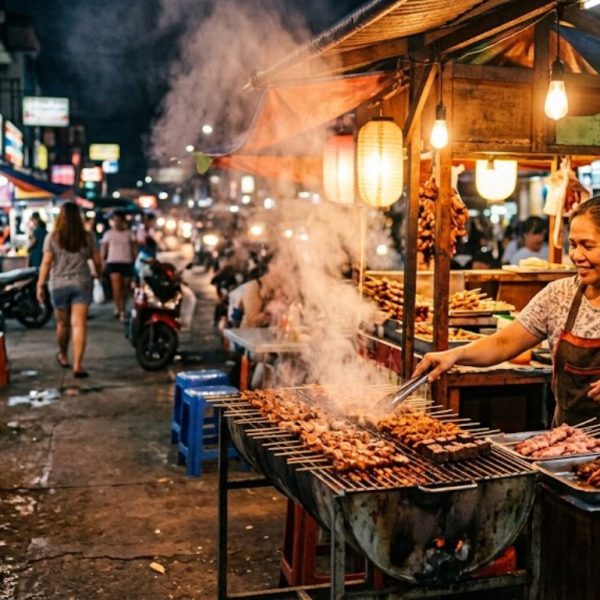
Ask anyone who has spent a rainy evening under a tarpaulin in Cebu City, balanced on a plastic stool with the charcoal glowing a metre away, and they will tell you the same thing. The real introduction to the Philippines does not happen in a hotel dining room. It happens at a cart, at dusk, when the skewers go on the grill and the whole block starts to smell of pork fat and vinegar. Filipino street food is cheap, noisy, occasionally alarming to first timers, and it remains the quickest route into the culture of the islands.
Why filipino street food tells you more than a guidebook
Food in the Philippines carries three centuries of Spanish rule, decades of American influence, centuries of Chinese trade and a much older Austronesian base underneath all of it. You taste that history in a single afternoon. The vinegar and garlic come from the pre colonial larder, the noodles arrived with Hokkien merchants, and the sweet spaghetti and fried chicken are twentieth century arrivals that Filipinos made entirely their own. Nobody sits you down and explains this. You just notice, somewhere around your fourth stall, that the country has absorbed everything and apologised for none of it.
That layering is why Filipino cuisine confuses visitors who arrive expecting the chilli heat of Thailand or the herb forward brightness of Vietnam. The Philippine palate runs sour, salty and sweet rather than hot. Once you stop waiting for spice and start noticing acid, the whole thing clicks into place.
The stalls to try first
Start with isaw, the marinated chicken or pork intestine threaded onto a bamboo stick, grilled hard over coals and dunked in a communal vinegar dip. It is the entry exam. If you pass, move on to betamax, cubes of coagulated pork blood named after the video cassette they resemble, and then to inihaw na liempo, grilled pork belly that needs no explanation at all.
Away from the grill, look for kwek kwek, quail eggs in a bright orange batter, and banana cue, saba bananas caramelised in brown sugar and skewered while still dangerously hot. Anyone hunting the best filipino food on a budget should also track down a bowl of goto, rice porridge with tripe and ginger, sold from steaming vats near jeepney terminals from about four in the morning. Rice, not bread, is the default carbohydrate here, and almost every stall assumes you want some.
Reading a cart before you order
The safest stall is a busy one. High turnover means the oil gets changed, the meat has not been sitting in the sun and the vendor has a reputation to protect among regulars who come back nightly. Watch where tricycle drivers and students queue, because they eat from carts constantly and they are ruthless about quality.
A few practical habits help. Carry small notes, because nobody at a cart wants to break a thousand peso bill. Ask the price before the food hits the plate, not because vendors are dishonest but because portions vary wildly. And take the vinegar dip seriously, since the acid does real work on grilled fat. Long time visitors trading notes about street food philippines on forums such as the r/Philippines community tend to give the same advice, which is to follow the crowd and to eat early rather than late.
Eating your way across an archipelago teaches you something that applies just as well closer to home: the distance between two places on a page is never the distance you actually travel. Anyone planning a long American drive runs into the same gap the moment they open a us national parks map and start pencilling in stops. Reading elevation, seasonal closures and driving hours before you commit is what turns a wish list into a trip that is genuinely enjoyable.
Food is one of the more honest introductions to a place, because it records history, trade and migration in a form you can actually taste. Reading it alongside global news gives a fuller picture of a country than either source manages alone. Culture and current affairs explain each other more often than they are presented together.
Regional flavours worth travelling for
Cebu is the country's roast pork capital, and lechon here is seasoned so aggressively with lemongrass, garlic and spring onion that it needs no sauce whatsoever. In Iloilo the obsession is batchoy, a pork and noodle soup thickened with crushed chicharon. Pampanga, north of Manila, claims sisig, the sizzling chopped pork jowl dish that has quietly conquered restaurant menus abroad. Bicol goes where the rest of the country will not, cooking with coconut milk and genuine chilli heat.
Language shifts along with the food. Cebuano, Ilonggo, Kapampangan and Tagalog all name the same dish differently, and a menu that made perfect sense in Manila may baffle you in Bacolod. The Philippines has well over a hundred living tongues, part of the wider family covered in this overview of the languages of Asia, and learning two or three food words in the local one buys you a surprising amount of goodwill.
When and where the carts appear
Timing matters more than location. Morning belongs to the porridge and rice cake vendors who set up near markets and terminals before dawn. The middle of the day is quiet, since the heat kills the appetite for anything grilled. Then around five in the afternoon the whole thing wakes up again, and by seven the pavements outside university gates, basketball courts and ferry piers are a wall of smoke and folding tables. Weekends and the run up to a fiesta bring out vendors you will never see otherwise.
In Cebu, the lanes around Colon Street and the stretches near the port are reliable after dark. In Manila, the areas around Quiapo and the campuses in España reward a slow walk with no fixed plan. The rule everywhere is the same. Go where people are already eating, order what the person ahead of you ordered, and do not overthink it.
The bigger picture
Street carts are not a lesser version of restaurant cooking. They are where a country records its daily appetite most honestly, and the Philippines is no exception to that rule. Anyone curious about how these habits compare elsewhere will find the same patterns repeating in accounts of street food around the world, from Bangkok to Mexico City. Eat filipino street food for a week and you will have learned more about the islands than any museum could teach you, for roughly the price of a single airport sandwich.